
One turret, two shotguns, one decision chain
Dron Kalkanı is an integrated close-in air defence system made up of the firing unit, the robotic turret, the passive sensor package and the processing power carried on the turret.
Everything on one turret
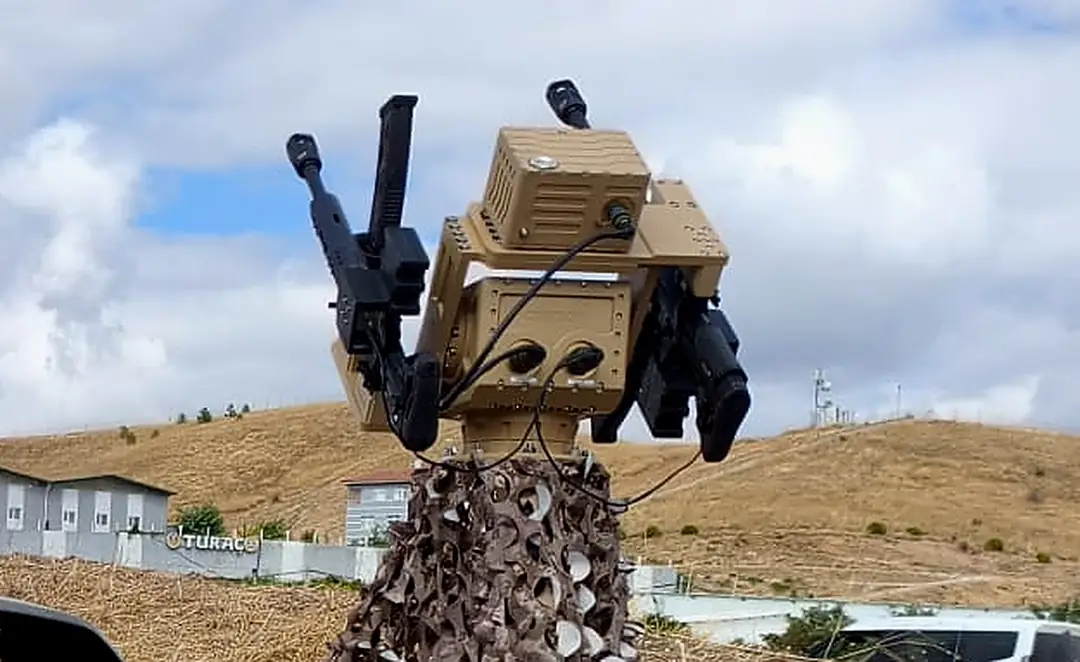
The turret carries both shotguns, the electro-optical sensor package, the acoustic sensors and the processing unit on a single structure. Because sensors and barrels share one body, no sensor-to-barrel alignment is lost.
Because no separate computer cabinet is needed, installation is simpler, cabling is reduced, and the turret can be added to an existing vehicle fleet.
- 01
2 × Derya MAX, 12-gauge semi-automatic
Gas-operated action, 76 mm magnum chamber, rapid fire from a 10- or 15-round magazine.
- 02
Electro-optical sensor package
Developed by Lasersan; detection, identification and uninterrupted tracking of the target on the turret.
- 03
Acoustic sensors
A second passive channel processed together with the image. Drones produce a characteristic acoustic signature.
- 04
Pan-tilt drive system
Designed to keep pace with sharply manoeuvring targets.
- 05
Embedded processors
Detection, classification and the firing solution are produced on the turret; no separate computer cabinet is needed.
A decision chain measured in seconds
Scan
Electro-optical and acoustic sensors on the turret scan the sky continuously. Fully passive: no emission, no signature.
Detect
An approaching target is detected from this range and taken under uninterrupted track on the turret.
Classify
Image and acoustic data are processed together; AI algorithms identify the target and compare it against the rules of engagement.
Track
Algorithms trained for drone-versus-drone engagement anticipate sudden manoeuvres; the firing solution is generated on the turret.
Engage
When the pre-defined conditions are met both shotguns fire simultaneously. The metal cloud defeats the target.
Why 150 metres
Dron Kalkanı targets the final link of a layered air defence architecture. The upper layers — systems with 12.7 to 40 mm guns supported by radars and jammers — work in a band reaching from hundreds of metres to a few kilometres. For a drone that gets past them, one line of defence remains: 150 metres and below.
One turret, three ways to task it
All three modes run on the same hardware. The mode is chosen according to the threat, the area of operations and the existing air defence architecture.
Autonomous
Once tasked, detection, classification, tracking and firing happen without human intervention. For fixed sites and convoys where a continuous manned watch is not practical.
Operator-controlled
The same turret can be operated from a remote command console. The engagement decision can be left entirely to the operator. For missions with restricted rules of engagement.
Defeat only
Another sensor or system detects the target; Dron Kalkanı delivers the engagement. Networked target data slews the turret, and the engagement begins the moment its own sensors acquire the target.
Autonomous does not mean unconstrained
With an autonomous weapon system the real question is not how fast it can fire but when it will not fire. The user sets the rules before the mission.
Engagement area
In autonomous mode the system operates only inside a pre-defined area.
Weapons-free sectors
Weapons-free status applies only in the sectors the user has defined.
No-fire zones
Zones in which the system will not fire under any condition can be defined.
Friendly discrimination
Discrimination of friendly aircraft is provided.
Emergency stop
The system can be disabled at any moment in a single action.
Full recording
All engagements are recorded as imagery and data.
Rules of engagement are the user’s decision, not the manufacturer’s. The system is configured to the user’s own engagement doctrine and does not behave outside that configuration. Recording is not an optional feature but the precondition of accountability.
System parameters
The table below carries the publicly available configuration data. Detailed performance figures, integration interfaces and mission planning parameters are in the datasheet, shared on request together with end-user information.
| Firing unit | 2 × Derya MAX 12-gauge semi-automatic, gas-operated |
|---|---|
| Chamber | 76 mm magnum |
| Ammunition | Sterling 12-gauge magnum anti-drone |
| Feed | 10 / 15-round magazine — rapid fire, multi-target engagement |
| Detection | Electro-optical sensor package + acoustic sensors (fully passive) |
| Radar | None — by design |
| Detection / tracking | From 600–800 m |
| Engagement range | 150 m |
| Turret | Pan-tilt, light and compact |
| Processing | Embedded low-power processors on the turret — no separate computer cabinet |
| Power | The platform’s existing power supply |
| Operator for engagement | 0 — no human in the loop in autonomous mode |
Export control
The product is subject to export control. A datasheet request will ask for organisation, country and end-user information; sharing may be conditional on authorisation by the competent authorities.
What threat are you positioning against?
Share your mission profile and our team will assess platform fit, integration and engagement conditions.