
600–800 m
Detection and tracking
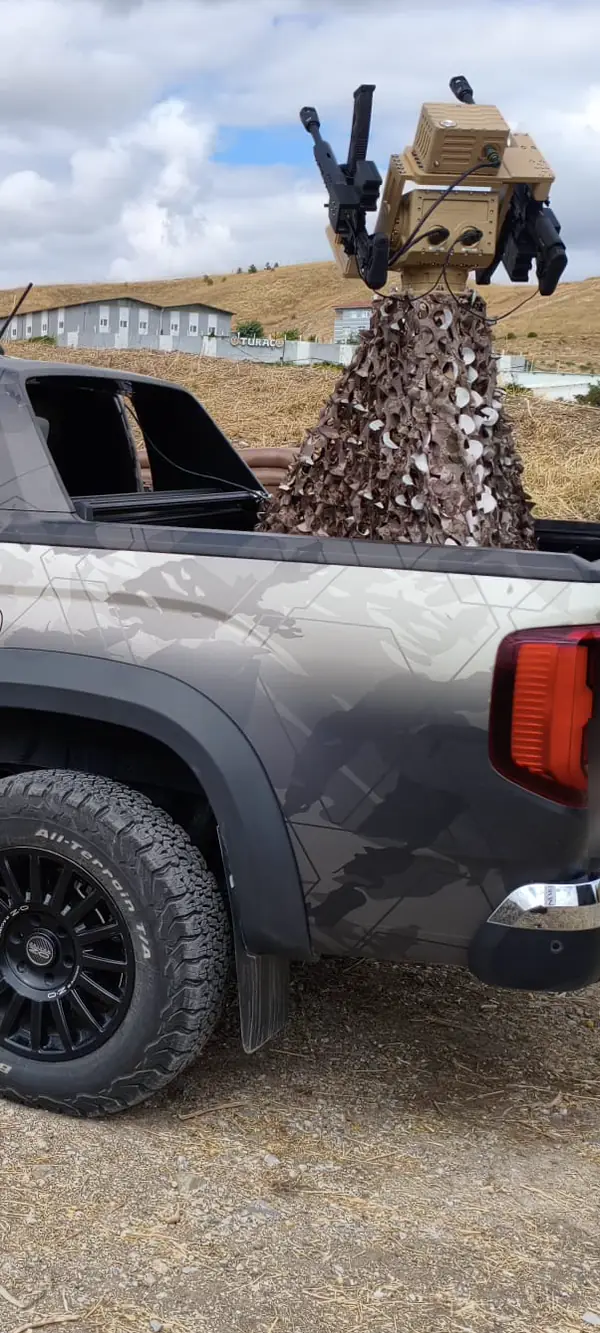
The last 150 metres are ours.
Autonomous close-in counter-drone system
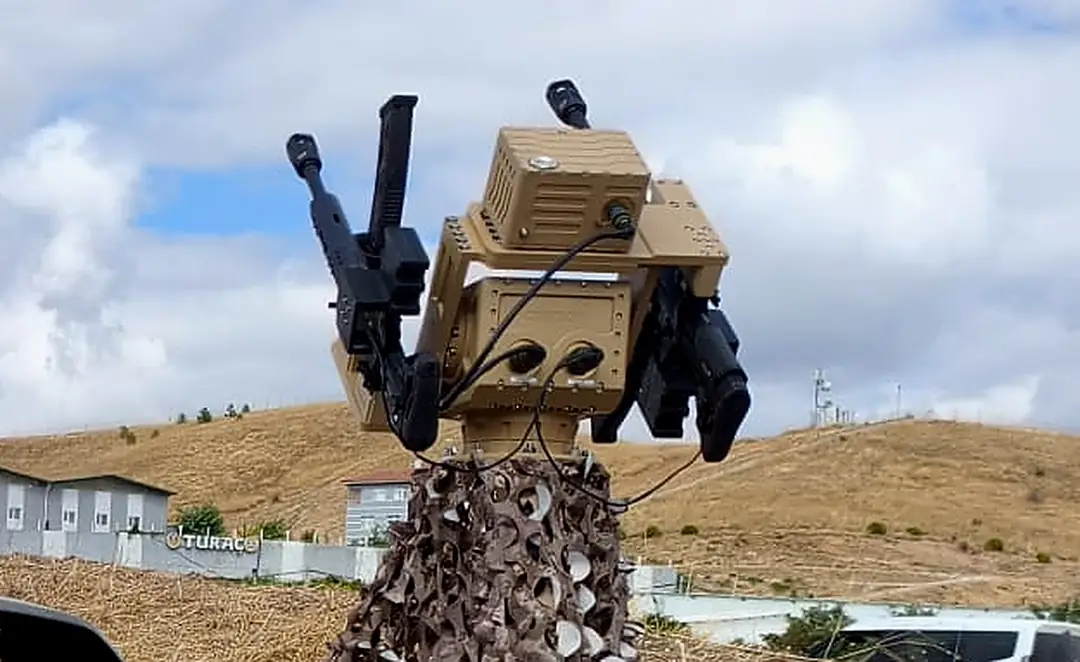
It begins where jamming ends. Two 12-gauge semi-automatic shotguns on a single autonomous robotic turret. Once activated it scans the sky, finds the target and engages — on its own.
The lesson from Ukraine is clear: FPV and kamikaze drones costing a few hundred dollars are destroying million-dollar platforms and unprotected personnel.
A growing share of this threat cannot be jammed. Drones controlled over fibre-optic cable emit no radio frequency; drones flying autonomously on a pre-loaded route receive no command. Jamming is ineffective against both.
One option remains: physically destroying the target before it reaches its own.
A small, fast, agile target is hard to hit with a single round. Dron Kalkanı solves that not by aiming better but by closing the target’s flight path.
Two Derya MAX 12-gauge semi-automatic shotguns fire simultaneously with Sterling magnum anti-drone ammunition. Two barrels double the density of the cloud.
A dense metal cloud forms ahead of the target. Instead of a point shot, the volume the target must cross is filled.
The cost of an engagement is limited to the cartridges used. A cheap answer to a cheap threat.
From the moment a drone appears on the horizon until it is defeated, the system runs five steps in sequence — all of them completed on the turret itself.
Electro-optical and acoustic sensors on the turret scan the sky continuously. Fully passive: no emission, no signature.
An approaching target is detected from this range and taken under uninterrupted track on the turret.
Image and acoustic data are processed together; AI algorithms identify the target and compare it against the rules of engagement.
Algorithms trained for drone-versus-drone engagement anticipate sudden manoeuvres; the firing solution is generated on the turret.
When the pre-defined conditions are met both shotguns fire simultaneously. The metal cloud defeats the target.
In drone attacks decision time is measured in seconds. The time an operator needs to look at a screen, confirm the target and pull the trigger is usually longer than the time the threat needs to reach you. Dron Kalkanı removes that loop.
Autonomous protection at fixed sites where a continuous manned watch is not practical.
Read more →Convoys and unitsClose-in defence against FPV and kamikaze drones targeting vehicles.
Read more →Commercial shippingFor bulk carriers and tankers that carry no air defence system.
Read more →Existing architectureA layer that works with jammers and radars and can take the defeat role alone.
Read more →Once activated, detection, tracking and firing are automatic. When the pre-defined engagement conditions are met, the system fires on its own. The same turret can also be run from a remote console when required.
Both the electro-optical and the acoustic sensors work passively. The system operates without a signature, and weight, power draw and cost on the turret all drop.
Detection, classification and the firing solution are produced on the turret itself, on embedded low-power processors. No separate computer cabinet is required.
It works alongside jammers, radars and the other layers of an air defence architecture. It can be cued by networked target data and take on the defeat role alone.
The lighter the turret, the more platforms it fits. That is why the system can work on anything from a commercial pickup to the deck of a bulk carrier.
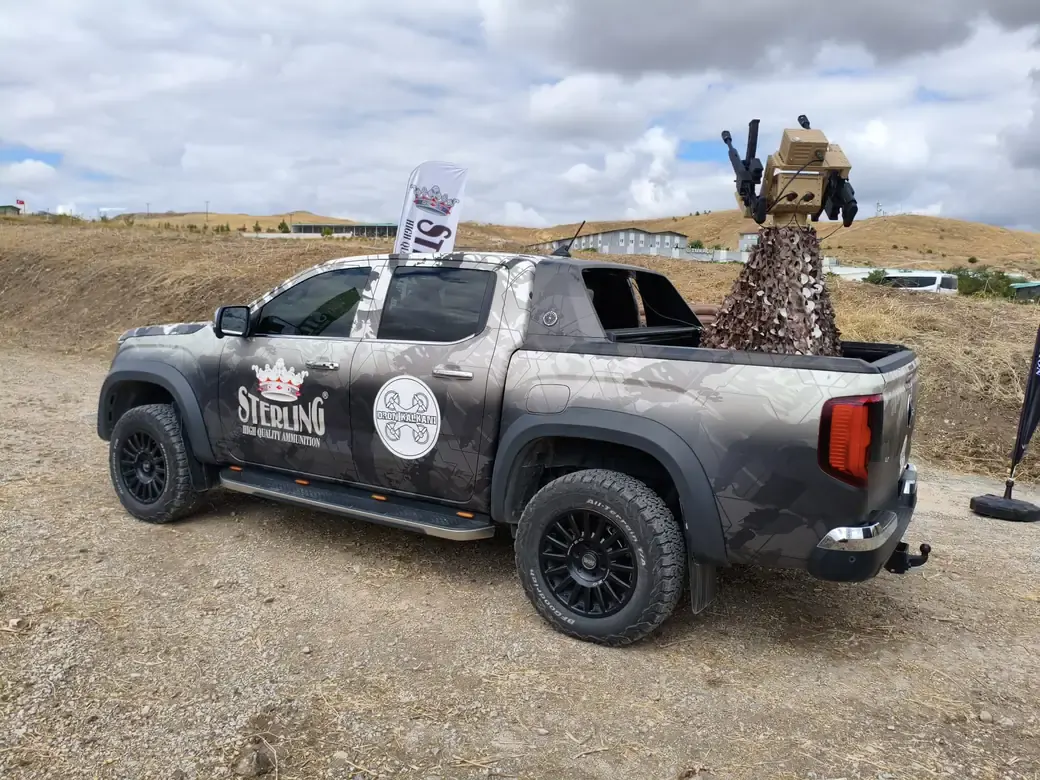
The turret scans its own sector while the crew stays under cover or inside the vehicle. Protection is provided without personnel in the threat area.
Dron Kalkanı is not one company’s product. Four Turkish companies with proven records in ammunition, small arms, robotics and electro-optics developed it together with İTÜ Havacılık ve Uzay Teknolojileri Uygulama ve Araştırma Merkezi (İTÜ ARC), the aerospace research centre of Istanbul Technical University.
Sterling-branded 12-gauge magnum anti-drone ammunition, produced in its own facilities.
12-gauge semi-automatic Derya MAX shotguns.
The robotic turret and the imaging systems; one of the main technology partners in system integration.
Mechanical design and integration of the turret onto vehicles.
Tracking and engagement algorithms developed for drone-versus-drone combat.
The system is being shown for the first time at the Turaç stand (4C-101) at the Istanbul Expo Centre. Visitors from 114 countries and buying delegations from 70 countries are expected. Contact us for demonstrations, technical discussions and distribution enquiries.
The eighth edition of the competition, held since 2017 and growing every year, takes place at the Gendarmerie Commando Marksmanship School in Foça, İzmir. The event is organised and coordinated by the Foça Gendarmerie Commando Training Command and JAVDESTUR, the brand of Jandarma Asayiş Vakfını Destekleme Anonim Şirketi. Dron Kalkanı will take part.
Share your mission profile and our team will assess platform fit, integration and engagement conditions.